Ayurveda Basics

Vidya · Ayurveda

Ayurveda Basics

॥ आयुर्वेदः अमृतानां श्रेष्ठः ॥

Ayuh + Veda — the eternal science of life. Health, longevity and balance through harmony with nature, the doshas and one's own constitution.

॥ ॐ ॥

Introduction

The Science of Life

॥ ॐ ॥

Ayurveda — from Ayuh (life) and Veda (knowledge) — is one of the oldest and most comprehensive systems of natural healing in the world. It is not merely medicine, but a complete science of conscious living.

Treating the person as a whole — body, mind and spirit — Ayurveda focuses on preserving health, preventing disease and promoting longevity through balanced diet, daily routine, herbs and spiritual practice. It is considered an Upaveda of the Atharvaveda, revealed by Brahma and carried through the lineage of Dhanvantari, Charaka and Sushruta. Over five thousand years on, it remains a living tradition.

The Ayurvedic Mission

Protect & Restore

स्वस्थस्य स्वास्थ्यरक्षणं
आतुरस्य विकारप्रशमनम् ॥

"To protect the health of the healthy, and to cure the disease of the sick."

Chapter I

Brihat Trayi — The Great Triad

The three foundational texts on which all of Ayurveda rests.

Charaka Samhita

The great classical text on internal medicine and Ayurvedic theory.

Sage Charaka

Sushruta Samhita

The foundational treatise on surgery, anatomy and surgical instruments.

Sage Sushruta

Ashtanga Hridaya

A concise, lucid summary of the Charaka and Sushruta Samhitas.

Vagbhata

Chapter II

Panchamahabhuta — The Five Elements

All matter — universe and body alike — is woven from these five.

Akasha

Ether / Space

Light · subtle · expansive

Vayu

Air

Dry · cold · mobile

Agni

Fire

Hot · sharp · transformative

Jala

Water

Liquid · cool · cohesive

Prithvi

Earth

Heavy · stable · solid

Chapter III

Tridosha — The Three Bio-Energies

The foundation of Ayurveda — health is the dance of these three in balance.

वात

Vata

Air + Ether

Governs

Movement, breathing, circulation, nervous system

In Balance

Creative, energetic, quick thinking, adaptable

Imbalance Signs

Anxiety, dryness, constipation, insomnia

पित्त

Pitta

Fire + Water

Governs

Digestion, metabolism, intelligence, vision

In Balance

Intelligent, sharp, focused, goal-oriented

Imbalance Signs

Anger, inflammation, acidity, skin issues

कफ

Kapha

Water + Earth

Governs

Structure, lubrication, immunity, stability

In Balance

Calm, stable, compassionate, strong

Imbalance Signs

Lethargy, weight gain, congestion, attachment

Each person carries a unique combination — known as one's Prakriti, the inborn constitution.

Chapter IV

Swasthya — The Five Pillars of Health

Ayurveda defines true health as balance across all five.

  • Balance of three Doshas (Vata, Pitta, Kapha)
  • Health of seven Dhatus (bodily tissues)
  • Proper elimination of three Malas (wastes)
  • Strong Agni (digestive fire)
  • Balanced state of mind and senses

Chapter V

Dinacharya — The Daily Routine

Living in rhythm with the cycles of the sun and the body's natural intelligence.

Brahma Muhurta

Rise Early

Wake before sunrise — the mind is naturally still and clear.

Morning

Warm Water

Drink warm water to kindle Agni and cleanse the channels.

Morning

Abhyanga

Daily warm oil self-massage to nourish tissues and calm Vata.

Morning

Yoga & Pranayama

Move the body, regulate the breath, prepare for the day.

Midday

Main Meal

Eat your largest meal when digestive fire is strongest.

Evening

Early Rest

Sleep before 10 PM to allow the body's natural repair.

Chapter VI

Ritucharya — The Six Seasons

Adjusting diet and lifestyle to the rhythm of the year.

Grishma — Summer

Pitta season

Cooling foods, sweet fruits, coconut water. Avoid spicy and oily.

Varsha — Monsoon

Vata aggravates

Warm, light, easily digested meals. Ginger tea and rest.

Sharad — Autumn

Pitta peaks

Sweet, bitter, astringent tastes. Ghee and milk soothe the body.

Hemanta — Winter

Kapha builds

Warm, nourishing meals, ghee, sesame oil. Stay active.

Shishira — Late Winter

Kapha season

Warming spices, lighter meals. Avoid heaviness and damp foods.

Vasanta — Spring

Kapha melts

Light, dry, bitter foods. Honey, warming spices, daily exercise.

Chapter VII

Ahara — The Role of Food

Ayurveda considers food itself as medicine — three qualities, three effects.

सात्त्विक

Sattvic

Pure, fresh, light. Fresh fruits, vegetables, whole grains, milk, ghee, nuts.

Effect

Clarity, peace, spiritual growth

राजसिक

Rajasic

Stimulating, spicy, salty, hot. Onion, garlic, coffee, excessive spice.

Effect

Activity, restlessness, ambition

तामसिक

Tamasic

Heavy, stale, processed, fermented. Old food, meat, alcohol.

Effect

Lethargy, dullness, ignorance

A Sattvic diet is recommended for sustained health, mental clarity and spiritual growth.

Deity of Ayurveda

Lord Dhanvantari

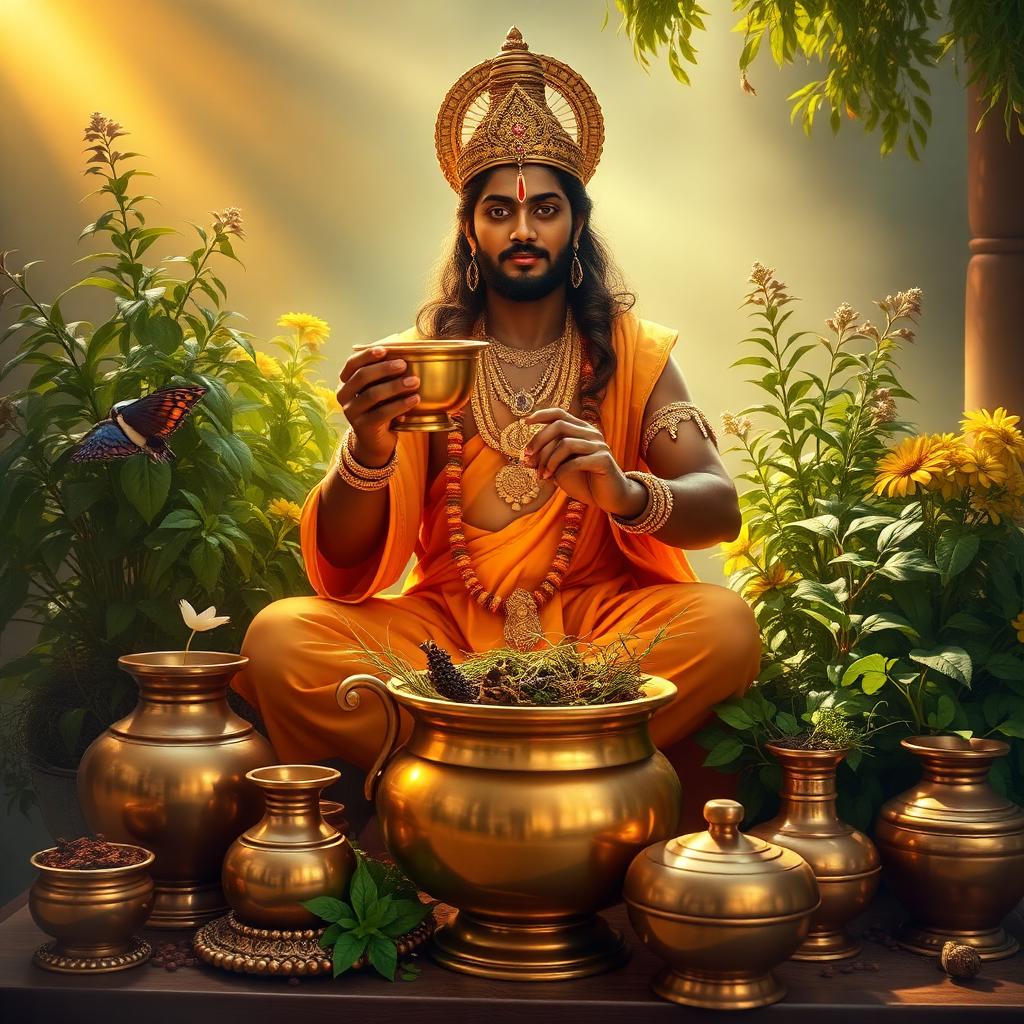
The divine physician of the gods, Lord Dhanvantari emerged from the churning of the cosmic ocean (Samudra Manthan) holding the pot of Amrita — the nectar of immortality — and the eternal knowledge of healing. Dhanteras, two days before Diwali, is celebrated in his honour.

ॐ धन्वन्तरये नमः

Chapter VIII

Modern Relevance

Ancient wisdom for a world reaching back to natural living.

Natural Healing

Holistic solutions for chronic conditions through diet, herbs and lifestyle.

Prevention First

Focuses on maintaining health, not merely curing disease.

Personalised

Recognises each person's unique Prakriti — no single prescription fits all.

Complements Modern Medicine

Addresses root causes and supports overall well-being.

Panchakarma

Time-tested deep detoxification therapies for body and mind.

Global Recognition

Embraced worldwide for sustainable, conscious living.

Ancient Saying

स्वास्थ्यं परमं भाग्यम् ॥

"Health is the greatest wealth."

Ayurveda is not just a medical system — it is a way of life. By understanding your unique Prakriti and living in harmony with nature, health becomes your natural state.

॥ ॐ शान्तिः शान्तिः शान्तिः ॥