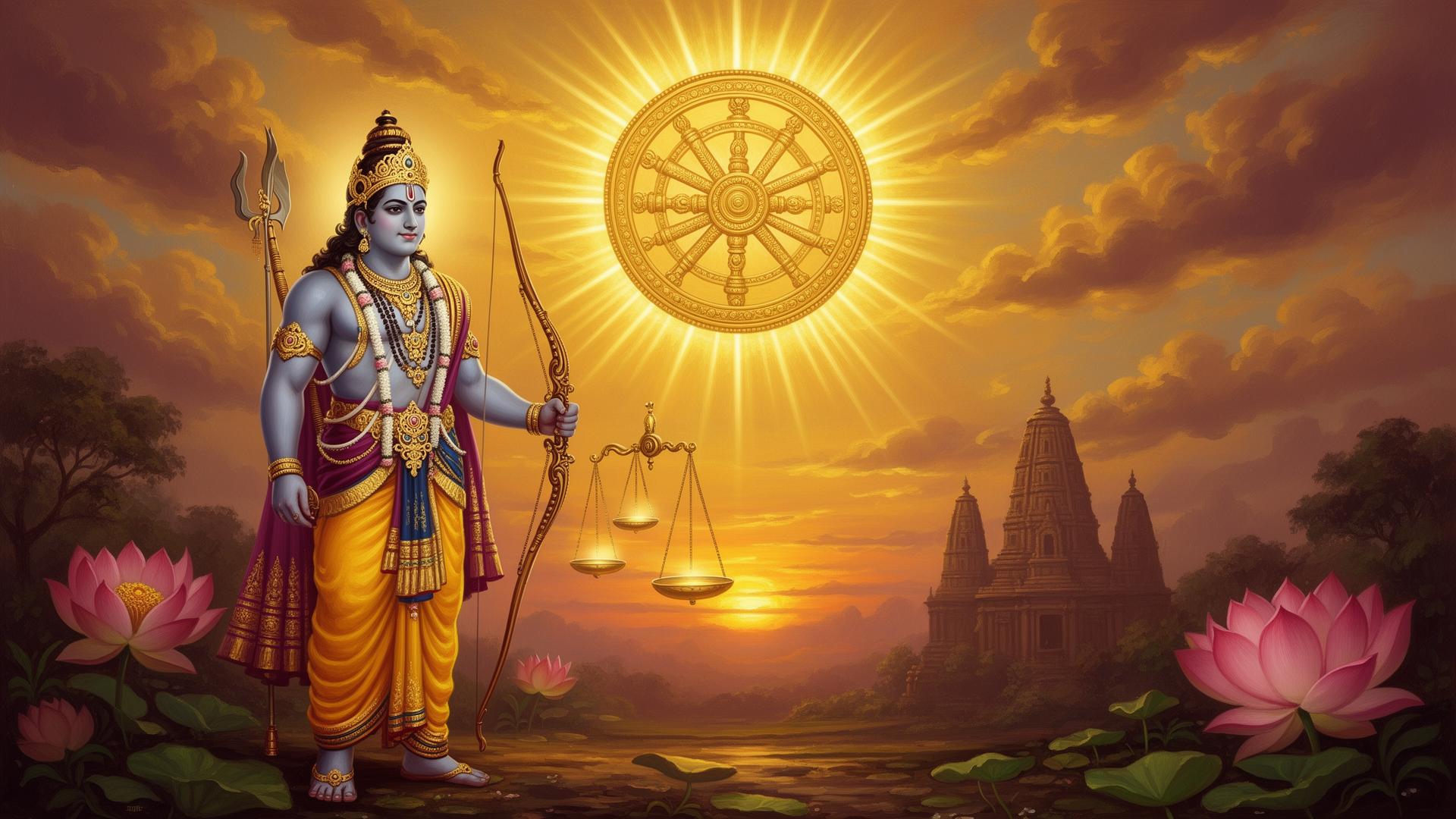
Dharma

Vidya · Dharma

Dharma

॥ धर्म एव हतो हन्ति धर्मो रक्षति रक्षितः ॥

That which sustains, upholds and supports — the eternal law of righteousness at the heart of Sanatan Dharma.

॥ ॐ ॥

Introduction

That Which Holds Everything Together

॥ ॐ ॥

Dharma is the most fundamental and central concept in Sanatan Dharma. Often translated as religion, duty, righteousness, or cosmic order, no single English word captures its depth. In its essence, Dharma is that which sustains, upholds and supports — the individual, society, and the entire universe.

The word comes from the Sanskrit root dhṛ — "to hold," "to support," "to maintain." Dharma is therefore the inner thread that holds all things together in harmony.

Chapter I

The Four Layers of Meaning

Dharma is one word with many depths.

Cosmic Order

The universal laws that maintain balance across all of creation.

Moral & Ethical Duty

Righteous conduct and living in accordance with truth.

Svadharma

One's personal duty — born of one's nature, stage of life and circumstances.

Spiritual Path

The way of life that leads to self-realisation and liberation.

The Importance of Dharma

Dharmo Rakṣati Rakṣitaḥ

When a person lives according to Dharma, they receive protection, peace and support from the universe itself. When Dharma declines, chaos and suffering rise.

धर्मो रक्षति रक्षितः

"Dharma protects those who protect Dharma."

Chapter II

The Six Kinds of Dharma

Dharma adapts to the universal, the personal, and the moment.

सनातन धर्म

Sanatana Dharma

Eternal universal principles

Example

Truth · Non-violence · Compassion

वर्ण धर्म

Varna Dharma

Duties based on one's nature and qualities

Example

Brahmin (teaching) · Kshatriya (protection)

आश्रम धर्म

Ashrama Dharma

Duties according to the stage of life

Example

Student · Householder · Retired · Renunciate

स्वधर्म

Svadharma

Personal duty based on nature and situation

Example

Arjuna fighting as a warrior

युग धर्म

Yuga Dharma

Duties specific to the age — especially Kali Yuga

Example

Chanting the holy name · Simple devotion

आपद् धर्म

Apad Dharma

Special conduct in times of crisis

Example

Flexibility in extreme situations

Chapter III

Dharma — First of the Four Purusharthas

Without Dharma, Artha and Kama lead to suffering. With Dharma, all become means of growth.

धर्म

Dharma

Righteous living — the foundation upon which all else rests.

अर्थ

Artha

Wealth and security, earned through Dharma.

काम

Kama

Legitimate desires and enjoyment, within the bounds of Dharma.

मोक्ष

Moksha

Liberation — the ultimate goal that Dharma leads to.

Chapter IV

Key Teachings on Dharma

From the Bhagavad Gita

It is better to follow one's own Dharma imperfectly than another's perfectly. To perform one's duty without attachment to results is the highest Karma Yoga.

From the Mahabharata

धर्म एव हतो हन्ति, धर्मो रक्षति रक्षितः

"Dharma destroyed destroys; Dharma protected protects."

From the Vedas & Upanishads

Satya (truth) is the highest Dharma. Ahimsa, truthfulness, purity and self-control are its pillars.

Chapter V

Exemplars of Dharma

Lives that show what Dharma looks like in action.

Lord Rama

Maryada Purushottama

Followed Dharma even at the cost of exile and separation from Sita — the supreme upholder of Dharma.

Yudhishthira

Dharmaraja

Held to truth and righteousness even in the most difficult moments of the Mahabharata.

Prahlada

Devotee of Vishnu

Chose devotion to the Lord over his father's commands — Dharma toward the Divine is supreme.

Ekalavya

The Perfect Disciple

Demonstrated the Dharma of a student through unmatched dedication and willing sacrifice.

Chapter VI

Dharma & Adharma

Two paths — two destinies.

Dharma

Adharma

Truth · honesty · compassion

Lies · deceit · cruelty

Selfless action

Selfish action

Protection of the weak

Exploitation of the weak

Harmony with nature

Destruction of nature

Inner peace · long-term good

Temporary pleasure · suffering

Eternal Verses

Words That Carry Dharma

॥ ॐ ॥

Mahabharata · Vana Parva

धर्मो रक्षति रक्षितः

"Dharma protects those who protect Dharma."

Bhagavad Gita 4.7

यदा यदा हि धर्मस्य ग्लानिर्भवति भारत । अभ्युत्थानमधर्मस्य तदात्मानं सृजाम्यहम् ॥

"Whenever there is a decline of Dharma and a rise of Adharma, O Bhārata, I manifest Myself."

Bhagavad Gita 3.35

स्वधर्मे निधनं श्रेयः परधर्मो भयावहः

"It is better to die following one's own Dharma than to follow another's, which is full of fear."

Chapter VII

Modern Relevance

Many of today's problems arise from the decline of Dharma. Its return begins with us.

Personal

Living with integrity, honesty and responsibility in daily life.

Family

Fulfilling duties toward parents, spouse and children with love and respect.

Professional

Working with ethics, fairness and excellence in every endeavour.

Social

Standing against injustice and contributing to the welfare of society.

Environmental

Protecting nature as part of our Dharma toward all living beings.

Bhagavad Gita 3.35

स्वधर्मे निधनं श्रेयः परधर्मो भयावहः

"It is better to die following one's own Dharma than to follow another's, which is full of fear."

Dharma is dynamic — adapting to time, place and circumstance — yet rooted in the unchanging principles of truth, compassion and righteousness. May we strive to understand and live by Dharma in every moment.

॥ ॐ शान्तिः शान्तिः शान्तिः ॥