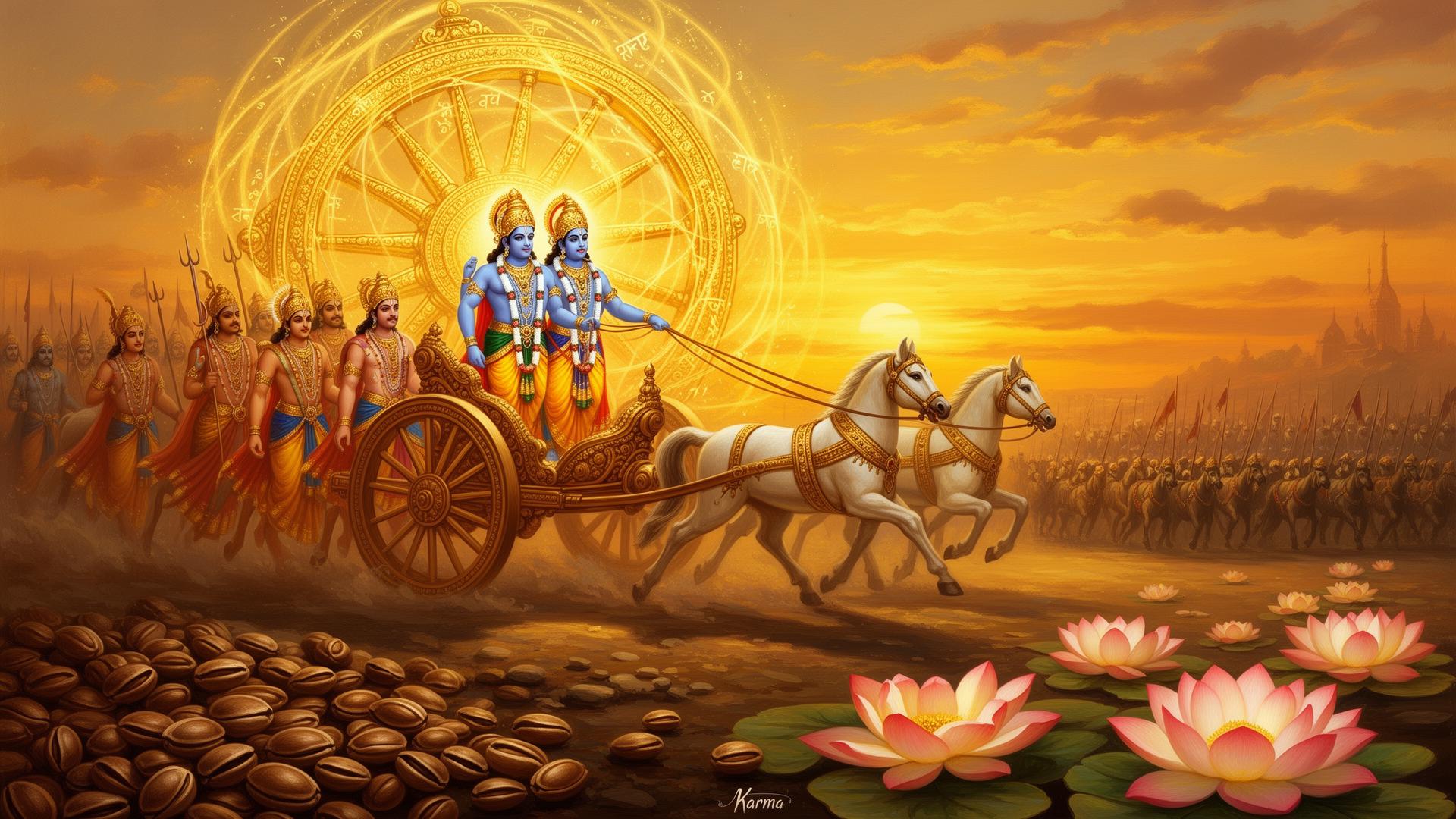
Karma

Vidya · Karma

Karma

॥ कर्मण्येवाधिकारस्ते ॥

The eternal law of action and consequence — every thought, word and deed shapes the soul's journey and the world.

॥ ॐ ॥

Introduction

The Law That Governs the Universe

॥ ॐ ॥

Karma is one of the most fundamental concepts in Sanatan Dharma. It refers to action and the law of cause and effect that governs the universe. The word comes from the Sanskrit root kṛ — "to do," "to act."

Every action — physical, verbal, or mental — produces a corresponding reaction. The law operates impartially and applies to all beings. Karma is not blind fate; it is the principle of moral causation.

Chapter I

What Karma Teaches

Good Action · Good Result

Right actions lead to happiness, growth and favourable circumstances.

Negative Action · Suffering

Harmful actions return as obstacles, sorrow and difficult conditions.

Across Lifetimes

Results may appear at once, or unfold across many lives. Nothing is ever lost.

Chapter II

The Law of Karma

Nothing happens by chance — every event has a cause, every action a consequence.

Impartial

Works without exception, equally for every being.

Accumulative

Results gather across lifetimes — the ledger is precise.

Modifiable

Conscious effort, repentance and good action can soften it.

Multi-Layered

Operates at the physical, mental and spiritual levels.

Chapter III

The Four Kinds of Karma

Past, present and future — woven into a single living ledger.

सञ्चित कर्म

Sanchita

Accumulated Karma from all past lives

Example

The total stock of past actions

प्रारब्ध कर्म

Prarabdha

Karma already bearing fruit in this life

Example

Current health, family, situations

क्रियमाण कर्म

Kriyamana

Karma being created in the present moment

Example

Actions performed right now

आगामी कर्म

Agami

Karma that will fruit in future lives

Example

Future results of today's choices

Some situations are due to Prarabdha — but we always have the freedom to create new Kriyamana Karma through today's choices.

Karma · Samsara · Moksha

Beyond the Wheel

Unresolved

Causes the soul to take rebirth.

Good

Leads to higher births and favourable conditions.

Negative

Brings suffering and lower states of being.

When all Karma is exhausted through knowledge, devotion and right action, the soul attains Moksha — and realises itself as the eternal Atman.

Chapter IV

Stories That Show the Law

Karma is precise and just — though its workings are not always immediately visible.

Dasharatha & Shravana

King Dasharatha accidentally killed Shravana's parents. The grief he caused returned to him as the unbearable pain of separation from his own son, Rama. Karma returns in similar forms.

Karna's Suffering

Despite being a peerless warrior, Karna faced curses and hardships rooted in past Karma — a reminder that even greatness is shaped by what was sown before.

Markandeya

Through intense devotion and luminous good Karma, the young sage Markandeya conquered death itself when Yama came to claim him.

Chapter V

How to Purify & Transcend Karma

Six pathways offered by the tradition.

Good Karma

Selfless service, charity, truthfulness and compassion.

Nishkama Karma

Act without attachment to results — the Gita's central teaching.

Prayaschitta

Sincere repentance and corrective action soften past Karma.

Bhakti

Surrender to God, chanting His names — devotion dissolves the heaviest Karma.

Jnana

Realising one's true Self dissolves the very sense of doership.

Yoga & Dhyana

Purify the mind and slow the creation of new Karma.

Eternal Verses

The Voice of Karma

॥ ॐ ॥

Bhagavad Gita 2.47

कर्मण्येवाधिकारस्ते मा फलेषु कदाचन । मा कर्मफलहेतुर्भूर्मा ते सङ्गोऽस्त्वकर्मणि ॥

"You have the right to action alone, never to its fruits. Let not the fruits be your motive, nor your attachment be to inaction."

Yatha Karma Tatha Phalam

यथा कर्म तथा फलम्

"As is the Karma, so is the fruit."

Upanishadic Saying

यद् बीजं तद् फलम्

"As you sow, so shall you reap — the quality of thought, word and deed becomes the texture of future experience."

Chapter VI

Modern Relevance

Karma helps make sense of life's inequalities and motivates lasting change.

Personal Responsibility

We are the creators of our own reality — no fate, no blame.

Ethical Living

A clear motivation for honesty, kindness and non-harm.

Comfort in Difficulty

Hardship is meaningful — and hope lies in present good deeds.

Long-Term Thinking

Choices today are seeds for tomorrow — and lifetimes to come.

Understanding Inequality

Helps make sense of life's disparities without bitterness.

Bhagavad Gita 2.47

कर्मण्येवाधिकारस्ते

"You have the right only to action, not to its fruits."

By performing our duties with dedication and without attachment, we purify our Karma and move steadily toward liberation. May we all sow positive Karma — and walk steadily toward lasting peace and freedom.

॥ ॐ शान्तिः शान्तिः शान्तिः ॥