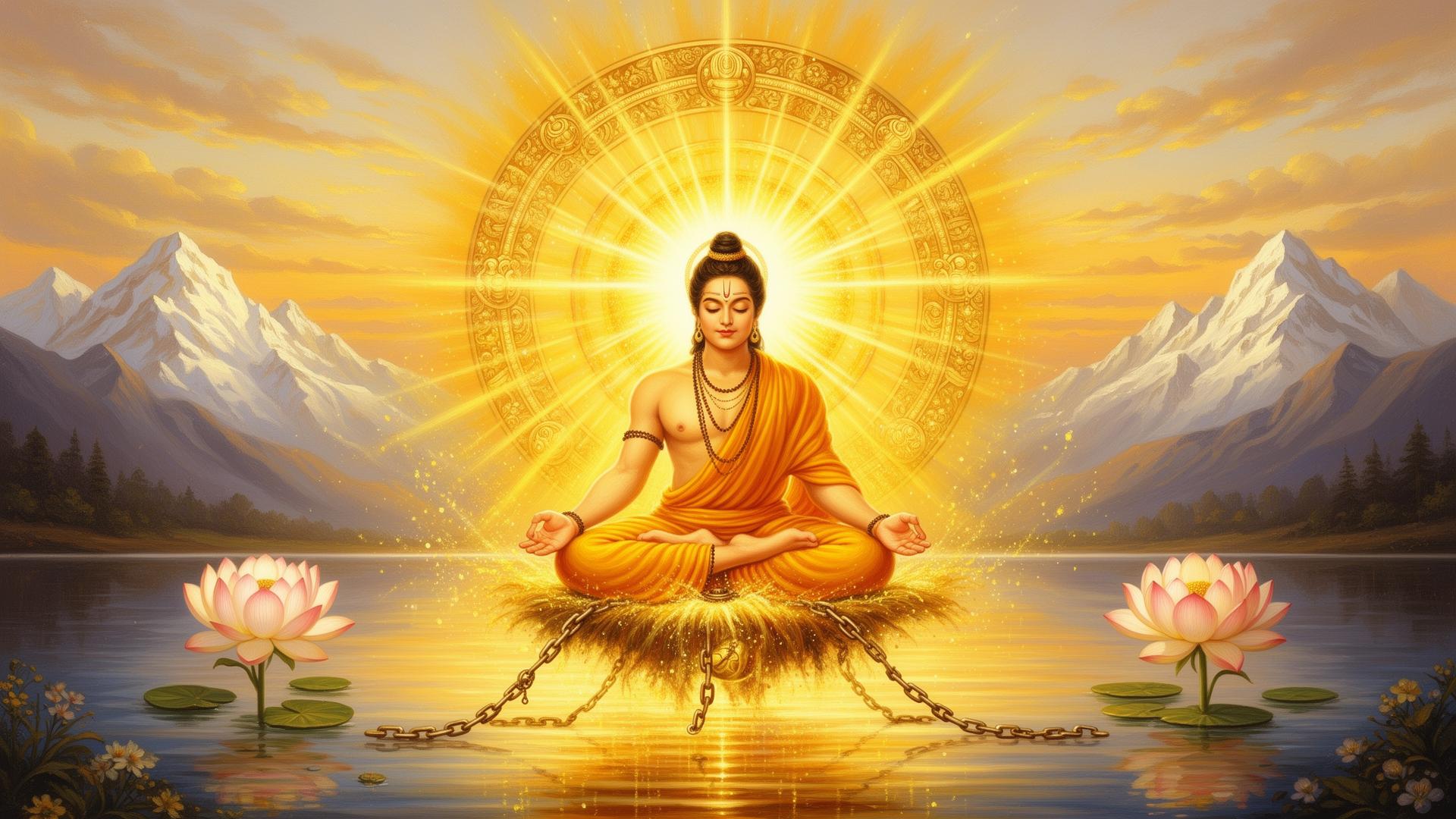
Moksha

Vidya · Moksha

Moksha

॥ मोक्षः परमं पुरुषार्थः ॥

Liberation — the highest of the four Purusharthas. Freedom from the cycle of birth and death, and the realisation of one's true nature as the eternal Self.

॥ ॐ ॥

Introduction

The Supreme Goal of Human Life

॥ ॐ ॥

Moksha is the ultimate goal of human life in Sanatan Dharma. The word comes from the Sanskrit root muc — "to free," "to release." It is the liberation of the soul from the cycle of birth and death (Samsara), freedom from suffering, and the realisation of one's true nature as the eternal Self (Atman).

While Dharma, Artha and Kama are essential to a balanced life, they exist to lead the seeker to Moksha. Without it, even great worldly success remains incomplete. The Bhagavad Gita and the Upanishads declare again and again — the very purpose of human birth is liberation.

Chapter I

Freedom From Four Bondages

Moksha is liberation from everything that binds the soul.

Samsara

The cycle of birth and death — endless rebirth.

Avidya

Ignorance of one's true nature as the eternal Self.

Ego & Desire

Attachment, craving and the false sense of doership.

Dukha

All forms of suffering — physical, mental, existential.

Tat Tvam Asi

Thou Art That

Moksha is the unshakable realisation that the individual soul (Atman) and the Supreme Reality (Brahman) are one and the same — never separate, never divided.

तत् त्वम् असि

— Chandogya Upanishad 6.8.7

Chapter II

The Four Paths to Liberation

Different roads — one summit. The Gita honours every temperament.

ज्ञान योग

Jnana Yoga

Path of knowledge and Self-inquiry — discerning the real from the unreal.

Scripture

Upanishads · Bhagavad Gita

Suited For

Intellectual seekers

भक्ति योग

Bhakti Yoga

Path of love and devotion — surrender to a personal Lord.

Scripture

Bhagavad Gita · Bhagavata Purana

Suited For

Devotional seekers

कर्म योग

Karma Yoga

Path of selfless action — duty performed without attachment to fruits.

Scripture

Bhagavad Gita

Suited For

Action-oriented people

राज योग

Raja Yoga

Path of meditation and mind control — the royal eight-limbed path.

Scripture

Yoga Sutras of Patanjali

Suited For

Those drawn to meditation

Chapter III

The Four Kinds of Liberation

Moksha has many dimensions — here, gradually, completely.

जीवन्मुक्ति

Jivan Mukti

Liberation while still living — the Self is realised, duties continue.

विदेहमुक्ति

Videha Mukti

Liberation upon leaving the body — full merging with Brahman.

क्रममुक्ति

Krama Mukti

Gradual liberation through successive stages and higher realms.

सायुज्यमुक्ति

Sayujya Mukti

Complete union with the Divine — especially in Vaishnava traditions.

Chapter IV

Liberated Souls

Moksha is open to every sincere seeker — regardless of background.

King Janaka

Though a ruler of a great kingdom, he attained Jivan Mukti through Self-knowledge while continuing to perform every worldly duty.

Prahlada

Born in a family of demons, his unbroken devotion to Vishnu burned away every karmic bond and granted him liberation.

Markandeya

Through unwavering devotion to Shiva, the young sage conquered death itself and entered the deathless state.

Nachiketa

In the Katha Upanishad, the boy Nachiketa chose knowledge of the Self over every worldly pleasure offered by Yama — and won immortality.

Chapter V

Obstacles on the Path

The veils that hide the Self — to be dissolved through sadhana.

  • ×Attachment to worldly pleasures
  • ×Ego and identification with the body
  • ×Ignorance of one's true nature
  • ×Accumulation of negative Karma
  • ×Lack of Viveka — discrimination between the real and the unreal

Eternal Verses

The Voice of Liberation

॥ ॐ ॥

Bhagavad Gita 18.66

सर्वधर्मान्परित्यज्य मामेकं शरणं व्रज । अहं त्वा सर्वपापेभ्यो मोक्षयिष्यामि मा शुचः ॥

"Abandoning all duties, take refuge in Me alone. I shall liberate you from all sins — do not grieve."

Chandogya Upanishad 6.8.7

तत् त्वम् असि

"Thou art That — the individual Self is identical with Brahman."

Brihadaranyaka Upanishad 1.3.28

असतो मा सद्गमय । तमसो मा ज्योतिर्गमय । मृत्योर्मा अमृतं गमय ॥

"Lead me from the unreal to the Real, from darkness to Light, from death to Immortality."

Chapter VI

Modern Relevance

In a restless world, Moksha is the deepest and steadiest freedom.

Higher Purpose

A meaning beyond temporary success, status and pleasure.

Inner Growth

Encourages Self-inquiry and freedom from unnecessary suffering.

Lasting Peace

The ultimate answer to the modern search for stress-free living.

Balanced Life

Holds worldly responsibility and spiritual aspiration in one hand.

Awareness, Not Escape

Moksha is not running from life — it is living it with full clarity and freedom.

Brihadaranyaka Upanishad 1.3.28

असतो मा सद्गमय ।
तमसो मा ज्योतिर्गमय ।
मृत्योर्मा अमृतं गमय ॥

"Lead me from the unreal to the Real. From darkness to Light. From death to Immortality."

Whether through Jnana, Bhakti, Karma or Dhyana, the path to Moksha is open to every sincere seeker. Not in a distant future — but here and now, through steady effort and grace.

॥ ॐ शान्तिः शान्तिः शान्तिः ॥