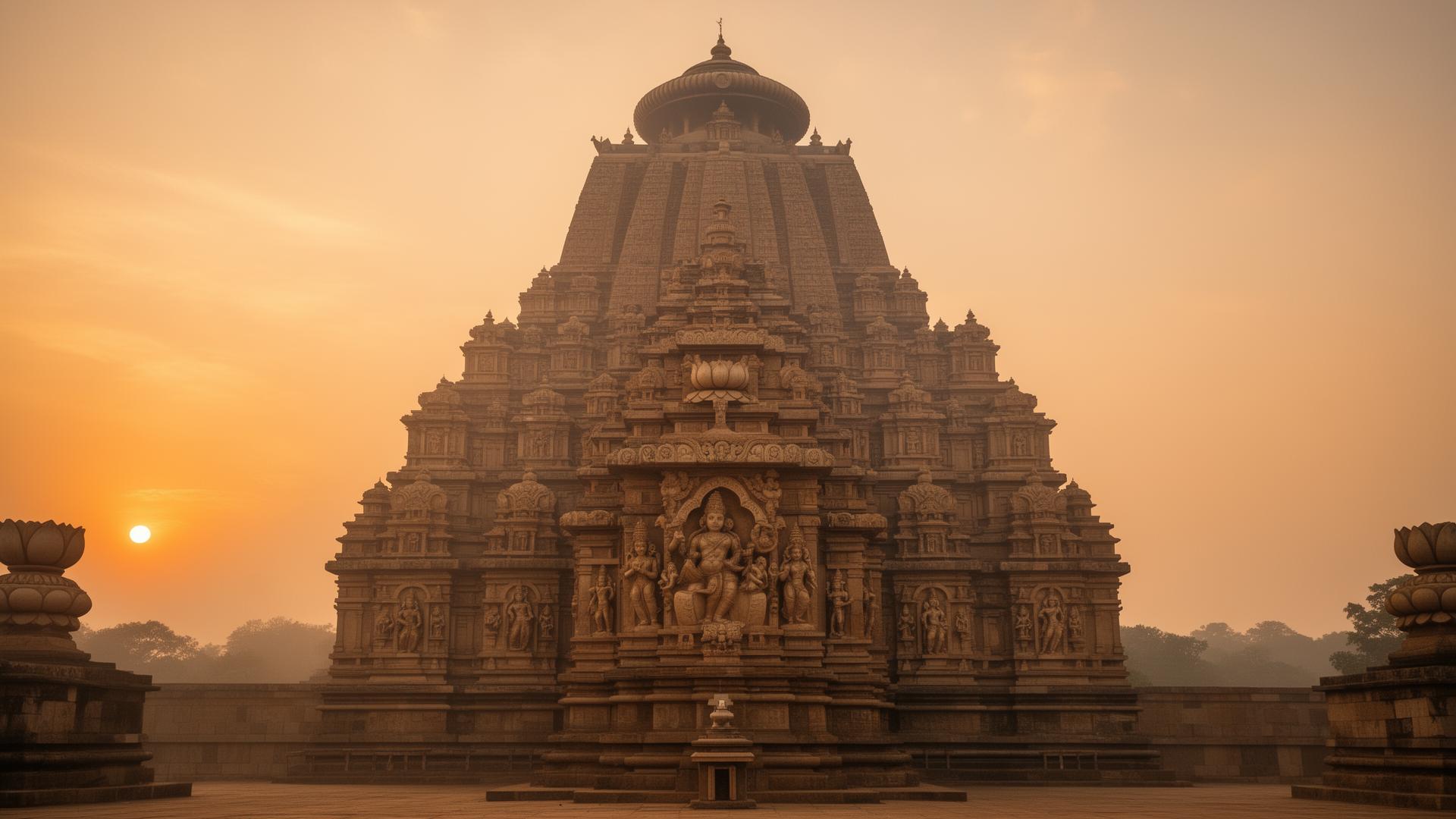
Temple Architecture

Vidya · Mandir Vastu

Temple Architecture

॥ मन्दिरं देवालयं ब्रह्माण्डस्य प्रतिरूपम् ॥

Hindu mandirs as microcosms of the universe — sacred geometry, cosmic symbolism and the timeless principles of Vastu Shastra.

॥ ॐ ॥

Introduction

A Sacred Cosmos in Stone

॥ ॐ ॥

Hindu temple architecture is one of the most magnificent and spiritually profound expressions of Sanatan Dharma. Temples are not merely places of worship — they are sacred spaces designed according to deep spiritual, philosophical and scientific principles.

In Sanskrit a temple is called Mandir or Devalaya — abode of the Divine. Guided by the ancient Vastu Shastra, Shilpa Shastra and the Agamas, every stone, proportion and carving carries symbolic meaning, designed to help the devotee move from the outer world to inner consciousness.

Purpose of the Mandir

Microcosm of the Universe

To create a sacred space where the Divine can be experienced. To move devotees from outer world to inner consciousness. To symbolise the journey from the material to the spiritual. To preserve and transmit wisdom through art and stone.

Chapter I

Core Principles of Design

The cosmic order made visible in every measurement and alignment.

Vastu Purusha Mandala

The sacred geometric grid representing the cosmic being — ensures harmony between structure and universe.

Axis & Symmetry

Most temples align east-west, with the sanctum facing the rising sun.

Vertical Symbolism

The temple rises like a mountain — the ascent from earthly to divine consciousness.

Sacred Geometry

Proportions, measurements and alignments follow precise mathematical and astronomical calculations.

Chapter II

Main Components of a Mandir

From the gateway to the innermost sanctum.

Garbhagriha

Sanctum Sanctorum

The innermost chamber where the main deity is installed — the womb of creation.

Shikhara / Vimana

Tower / Spire

The towering structure above the sanctum, symbolising Mount Meru, the cosmic mountain.

Mandapa

Pillared Hall

Where devotees gather for worship, kirtan and ritual.

Ardha Mandapa

Entrance Porch

The threshold leading into the main hall — transition from world to sanctuary.

Prakara

Outer Walls

Enclosing walls bearing carvings of deities, epics and decorative motifs.

Gopuram

Gateway Tower

Grand ornate gateway towers, especially prominent in South Indian temples.

Pushkarini

Sacred Tank

A sacred water body for ritual bathing before entering the temple.

Chapter III

The Three Great Styles

Nagara of the north, Dravida of the south, Vesara of the Deccan.

नागर

Nagara

North Indian

Features

  • Tall, curvilinear Shikhara
  • Square sanctum
  • Often crowned with multiple spires

Famous Examples

  • Khajuraho Temples — Madhya Pradesh
  • Sun Temple, Konark — Odisha
  • Lingaraj Temple, Bhubaneswar
  • Kedarnath Temple — Uttarakhand

द्राविड

Dravida

South Indian

Features

  • Stepped, pyramid-like Vimana
  • Grand Gopurams at the entrances
  • Enclosed by high Prakara walls

Famous Examples

  • Brihadeeswarar, Thanjavur
  • Meenakshi Amman, Madurai
  • Ranganathaswamy, Srirangam
  • Shore Temple, Mahabalipuram

वेसर

Vesara

Deccan — Hybrid

Features

  • A blend of Nagara and Dravida
  • Star-shaped sanctum bases
  • Intricate soapstone carvings

Famous Examples

  • Hoysaleswara, Halebidu
  • Chennakesava, Belur
  • Virupaksha, Hampi

Chapter IV

Symbolism in Every Stone

Every element of the temple carries deep meaning.

  • Garbhagriha: The womb of the universe — and the heart of the devotee.
  • Shikhara / Vimana: Mount Meru — the cosmic axis and ascent of the soul toward the Divine.
  • Mandapa: The body — where the devotee prepares to meet the Divine within.
  • Gopuram: A grand invitation — the transition from outer world to sacred space.
  • Sculptures: Visual scriptures — depicting Puranas, epics and the leelas of the divine.
  • Overall Form: The human body — sanctum as the heart, tower as the crown of consciousness.

Chapter V

A Devotee's Journey Through the Mandir

The very path through a temple is a sadhana.

1

Outer Courtyard

Transition from worldly life — leave the noise of samsara behind.

2

Mandapa

Preparation and purification of mind — chanting, stillness, surrender.

3

Garbhagriha

Direct communion with the Divine in the innermost sanctum.

4

Pradakshina

Clockwise circumambulation around the sanctum — aligning with cosmic order.

Each step is a movement inward — from the outer courtyard to the heart of the Divine.

Chapter VI

Glorious Mandirs of Bharat

Living masterpieces of devotion and skill.

Brihadeeswarar — Thanjavur

A masterpiece of Dravida architecture with the tallest vimana of its time.

Sun Temple — Konark

Designed as a colossal stone chariot with 24 wheels drawn by 7 horses.

Khajuraho Temples

Renowned for their intricate, expressive sculptures and Nagara spires.

Ramanathaswamy — Rameshwaram

Famed for one of the longest pillared corridors in the world.

Chapter VII

Modern Relevance

New temples around the world continue to be built following traditional Vastu and Shilpa Shastra principles. Ancient mandirs are being lovingly preserved, and their artistic and spiritual heritage is studied by architects, designers and seekers alike.

The sacred geometry of the mandir reminds us that beauty, mathematics and devotion are not separate — they are one continuous offering.

"As one enters a Hindu temple, one is not just visiting a building — one is entering a cosmic experience designed to awaken the soul."

॥ ॐ नमः शिवाय ॥