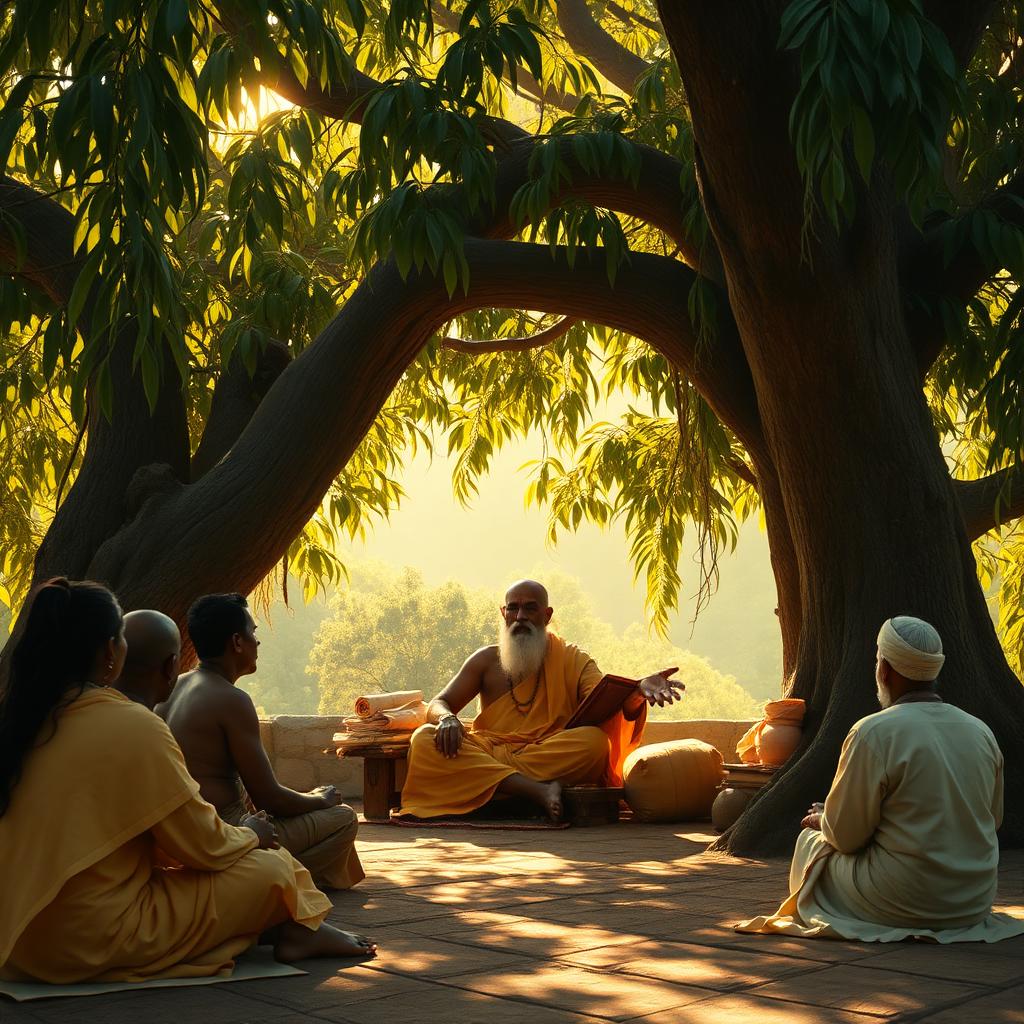
Vedanta

Vidya · Vedanta

Vedanta

॥ अहं ब्रह्मास्मि ॥

The end of the Vedas — the highest knowledge of Brahman, the Self, and the non-dual Reality that underlies all existence.

॥ ॐ ॥

Introduction

The Crown of the Vedas

॥ ॐ ॥

Vedanta literally means "the end of the Vedas" (Veda + Anta) — the philosophical teachings found at the conclusion of the Vedic literature, primarily in the Upanishads. It is also called Uttara Mimamsa, the later inquiry that follows the ritualistic portion of the Vedas.

Vedanta is the highest and most subtle knowledge of the Vedas — the direct realisation of the Supreme Reality (Brahman) and the true nature of the Self (Atman). It is centred on three eternal questions: What is Reality? What am I? What is the relationship between the two?

The Central Teaching

One Reality, Many Appearances

"Brahman is the only Reality. The world is an appearance. The individual Self is not different from Brahman."

अहं ब्रह्मास्मि

— Brihadaranyaka Upanishad 1.4.10

Chapter I

The Prasthanatrayi — Three Foundations

Every school of Vedanta stands upon these three authoritative texts.

Upanishads

The philosophical portion of the Vedas — revealed knowledge of Brahman and Atman.

Shruti · Revealed

Bhagavad Gita

The essence of the Upanishads delivered as a living dialogue between Krishna and Arjuna.

Lord Krishna

Brahma Sutras

A systematic summary of Upanishadic teachings in concise aphorisms.

Sage Vyasa

Chapter II

The Five Major Schools

Different acharyas — different lenses — one luminous truth.

अद्वैत

Advaita

Non-dualism

Founder · Adi Shankaracharya

Only Brahman is real; the world is an appearance (Maya). Atman and Brahman are one.

विशिष्टाद्वैत

Vishishtadvaita

Qualified Non-dualism

Founder · Ramanujacharya

Souls and world are real, but eternally dependent on Brahman (Vishnu).

द्वैत

Dvaita

Dualism

Founder · Madhvacharya

God, souls and world are eternally distinct realities.

भेदाभेद

Bhedabheda

Difference & Non-difference

Founder · Nimbarka · Vallabha

The soul is both different and non-different from Brahman.

शुद्धाद्वैत

Shuddhadvaita

Pure Non-dualism

Founder · Vallabhacharya

The world is a real and pure manifestation of Brahman, not illusion.

Chapter III

Key Concepts of Vedanta

The vocabulary of the highest knowledge.

Brahman

The Supreme, infinite, eternal Reality — beyond name and form, yet the source of all.

Atman

The individual Self — in essence, not different from Brahman.

Maya

The mysterious power that makes the One appear as many — the cause of the world.

Avidya

Ignorance — the root cause of bondage and identification with body and mind.

Moksha

Liberation through Self-knowledge (Atma Jnana) — freedom from ignorance and rebirth.

Chapter IV

Paths to Realise Vedanta

Vedanta emphasises Jnana, yet welcomes every sincere path.

ज्ञान योग

Jnana Yoga

Direct Self-inquiry — 'Who am I?'

भक्ति योग

Bhakti Yoga

Devotion that purifies the mind and opens it to knowledge.

कर्म योग

Karma Yoga

Selfless action that prepares the mind for higher wisdom.

राज योग

Raja Yoga

Meditation and concentration that still the mind.

Chapter V

Stories of Vedantic Truth

The highest teaching transmitted through dialogue and life.

Svetaketu

In the Chandogya Upanishad, his father teaches him 'Tat Tvam Asi' using salt dissolved invisibly in water — showing how Brahman pervades all.

King Janaka & Yajnavalkya

A profound royal dialogue on the nature of the Self, Brahman and the witness within — the heart of the Brihadaranyaka Upanishad.

Adi Shankaracharya

In a brief life of thirty-two years, he revived Advaita Vedanta through commentaries on the Prasthanatrayi and established four mathas across India.

Mahavakyas

The Great Sayings

॥ ॐ ॥

Chandogya Upanishad 6.8.7

तत् त्वम् असि

"Thou art That — you, the individual Self, are Brahman."

Brihadaranyaka Upanishad 1.4.10

अहं ब्रह्मास्मि

"I am Brahman."

Taittiriya Upanishad 2.1.1

सत्यं ज्ञानम् अनन्तं ब्रह्म ॥

"Brahman is Truth, Knowledge and Infinite."

Chapter VI

Modern Relevance

An eternal philosophy for the age of inquiry.

Scientific & Logical

A reasoned, inquiry-based approach to spirituality — not blind belief.

Unity in Diversity

Sees the same Divine essence in all beings and traditions.

Inner Peace

Self-inquiry and meditation as practical tools for clarity and calm.

Inspires Thinkers

Vivekananda, Aurobindo, Schrödinger, Tesla — all drew from Vedanta.

The Eternal Question

Addresses humanity's deepest inquiry — Who am I?

Taittiriya Upanishad

सत्यं ज्ञानम् अनन्तं ब्रह्म ॥

"Brahman is Truth, Knowledge and Infinite."

Vedanta does not ask us to believe blindly. It invites us to inquire, reflect and directly experience the truth for ourselves — leading from the unreal to the Real, from darkness to Light, from mortality to Immortality.

॥ ॐ शान्तिः शान्तिः शान्तिः ॥