Sovereign Goddess of Madurai

Mīnākṣī Ammaṉ

Sovereign Goddess of Madurai

॥ श्री मीनाक्षी सुन्दरेश्वराय नमः ॥

The fish-eyed warrior queen and her consort Sundareśvara — the eternal divine marriage at the heart of Tamiḻ Nāḍu.

॥ ॐ ॥

One of 51

Shakti Peethas

14 Towers

Gopurams

52 m · South

Tallest Tower

Nāyak · 17th c.

Built by

Introduction

The Fish-Eyed Queen of Madurai

॥ जय मीनाक्षी ॥

In the ancient city of Madurai, where the Vaigai river runs through the heart of Tamiḻ Nāḍu, rises the Mīnākṣī Sundareśvara Mandir — one of the 51 Śakti Pīṭhas, supreme abode of Goddess Mīnākṣī and her consort Sundareśvara, a form of Shiva.

Unlike most temples in Hinduism, here it is the Goddess who rules. Her shrine is larger, entered first, and worshipped above all. Sundareśvara — the "Beautiful Lord" — comes every night from his own shrine to hers. In Madurai, the order of the world is reversed: Śakti precedes Śiva.

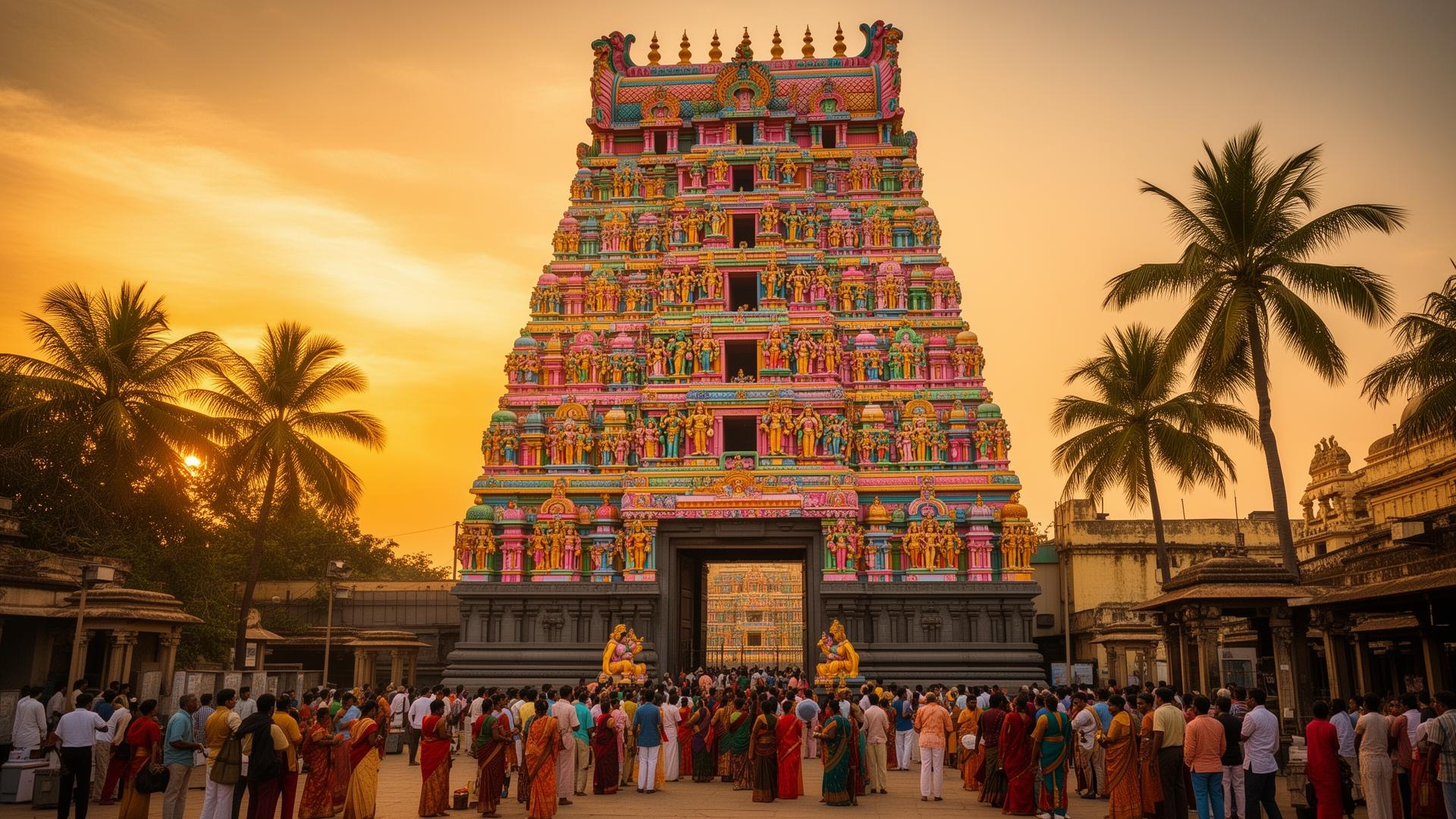
The temple is a city in itself — fourteen towering gopurams covered in over thirty-three thousand brightly painted figures, the Golden Lotus Tank at its centre, and the Hall of a Thousand Pillars echoing with two thousand years of Tamiḻ devotion. To enter is to walk into a living mandala of the cosmos, with the Mother at the very heart.
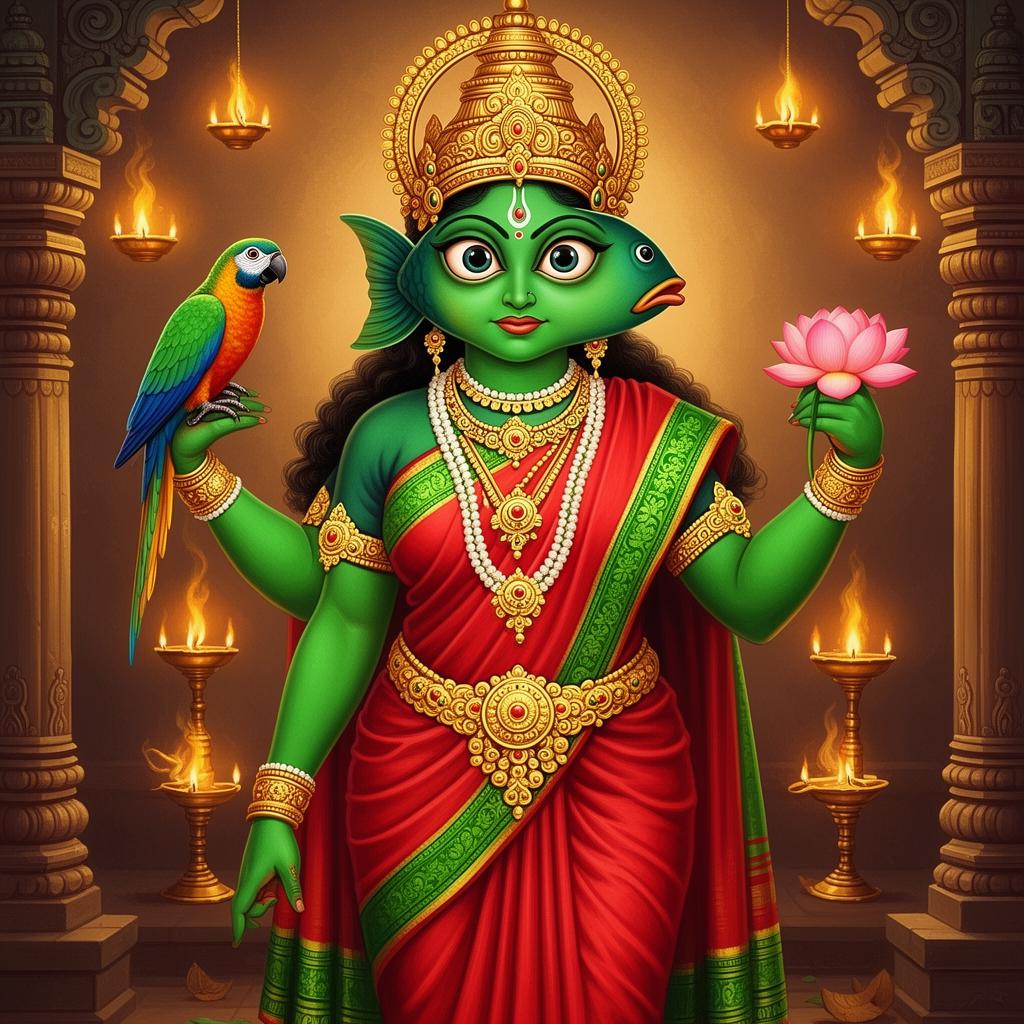
Goddess Meenakshi — the fish-eyed queen with parrot and lotus
Śrī Mīnākṣī — green-hued, lotus and parrot in hand

Chapter I

Why Madurai is Supreme

Six teachings that make Mīnākṣī unlike any other Goddess in Hinduism.

Sovereign Goddess

Mīnākṣī is no mere consort — she is the reigning queen of Madurai. Her shrine is larger and entered first, even before Sundareśvara's.

Warrior Queen

Born with three breasts as prophesied, she conquered every direction with her army — until the moment her eyes met Shiva's on Kailāsa.

Union of Śiva & Śakti

The temple's heart is the eternal marriage of consciousness and energy — Sundareśvara and Mīnākṣī, never apart, ruling Madurai together.

Shakti Peetha

Where the left breast of Devī Satī is said to have fallen. The Goddess here is Mīnākṣī and her Bhairava is Sundareśvara.

Heart of Tamil Bhakti

Glorified by the Nāyaṉmār and Āḻvārs, sung in Saṅgam poetry — Madurai has been the literary and devotional capital of Tamiḻ Nāḍu for two millennia.

Living Cosmos

The temple is laid out as the universe in miniature — the Pōtṟāmaraikuḷam tank at its centre, the gopurams marking the directions, the Goddess at the heart.

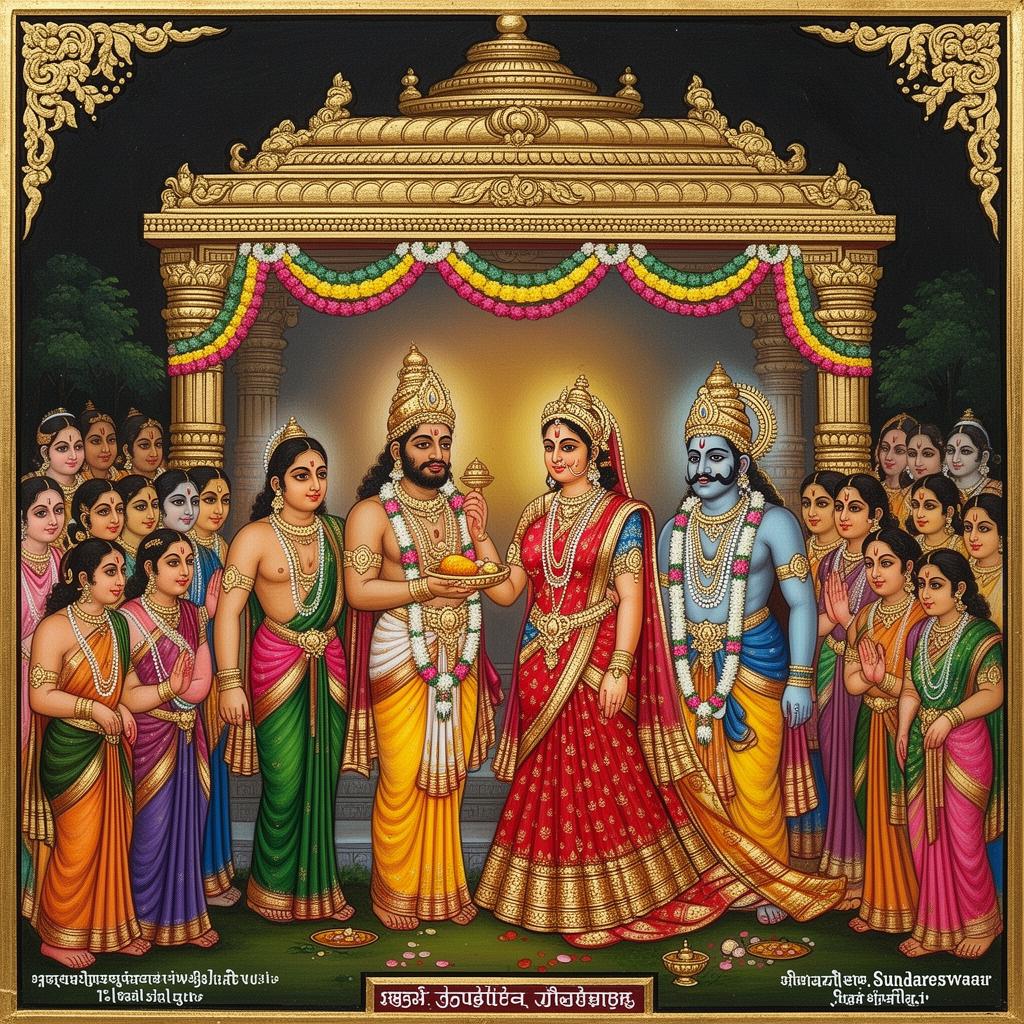
The divine wedding of Meenakshi and Sundareswarar

The Origin · Tiruviḷaiyāḍal Purāṇa

The Warrior Queen Who Became a Bride

King Malayadhwaja Pāṇḍya and his queen Kāñcanamālā performed great penance for a child. From the sacrificial fire rose a three-year-old girl — radiant, fierce, with three breasts. A divine voice spoke: "Raise her as a son. The third breast will vanish the moment she meets her destined lord." She was named Mīnākṣī — "she whose eyes are shaped like fish" — for she beheld all directions at once. She grew into a warrior queen, conquered every kingdom, and finally marched upon Kailāsa itself. There she saw Sundareśvara — the Beautiful Lord — and in that single glance her warrior's heart melted, the prophesied breast vanished, and she knew him as her own. The Mīnākṣī Tirukkalyāṇam — celebrated every Chittirai — re-enacts that cosmic moment when Śakti met Śiva, and ruled with him forever after.

उद्यद्भानुसहस्रकोटिसदृशां केयूरहारोज्ज्वलाम् ॥

"Radiant as a thousand suns, blazing with bracelets and necklaces — I bow to Mīnākṣī." — from the Mīnākṣī Pañcaratnam of Śaṅkarācārya

Chapter II

Two Millennia in Madurai

From the Saṅgam poets to Thirumalai Nāyak — the unbroken story of the Goddess's city.

Saṅgam Era

Madurai (Maturai) is celebrated in Tamiḻ Saṅgam literature as a city built around the goddess and the Vaigai river.

6–9th c. CE

Glorified by Tirujñānasambandhar and other Nāyaṉmār saints in the Tēvāram — Madurai is established as a great Śaiva centre.

Early Pāṇḍyas

The first stone shrines are raised by the Pāṇḍya kings, whose capital is Madurai itself. The temple becomes the seat of their kingdom.

14th c.

Sacked during the invasions of Malik Kāfūr. Worship continues in concealment; pieces of the original shrines are hidden and later recovered.

1623–1655 CE

Thirumalai Nāyak raises the temple to its present scale — fourteen gopurams, the Hall of a Thousand Pillars, the Pudu Maṇḍapam and the great corridors.

Modern Era

Active worship every day. The annual Chittirai Tiruvilā remains one of the largest temple festivals in Tamiḻ Nāḍu.

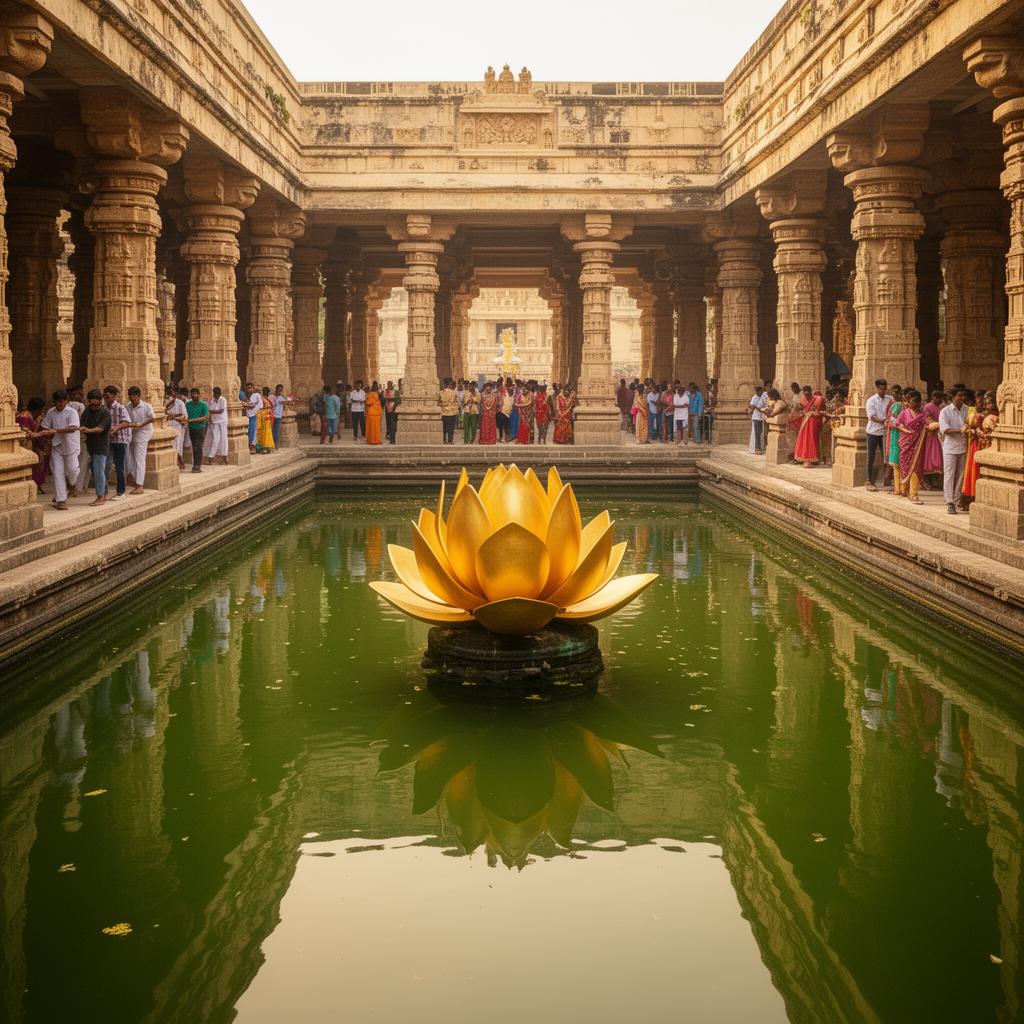
The Golden Lotus Tank — Potramarai Kulam

Sacred Heart

Pōtṟāmaraikuḷam — The Golden Lotus Tank

॥ पोट्रामरै ॥

At the centre of the temple lies the Pōtṟāmaraikuḷam — the "Tank of the Golden Lotus" — surrounded by pillared corridors painted with scenes from the Tiruviḷaiyāḍal Purāṇa. A single golden lotus rises from its still green water at the centre.

Tradition holds that this was the very tank in which the Tamiḻ Saṅgam of ancient Madurai tested the worth of every poem: works of true merit floated upon the golden lotus, while inferior compositions sank. To circumambulate the tank is to walk through the literary and spiritual heart of the Tamiḻ world.

Chapter III

A City Carved in Stone

Fourteen gopurams, a thousand pillars, and corridors that ring with music.

Fourteen Gopurams

The towers rise in concentric rings — outer ones taller, inner ones golden. Together they bear over 33,000 stucco sculptures, each a story.

Pōtṟāmaraikuḷam — Golden Lotus Tank

The sacred tank at the heart of the temple, with a golden lotus at its centre. Tradition says it was here that the Tamil Saṅgam tested the worth of every poem.

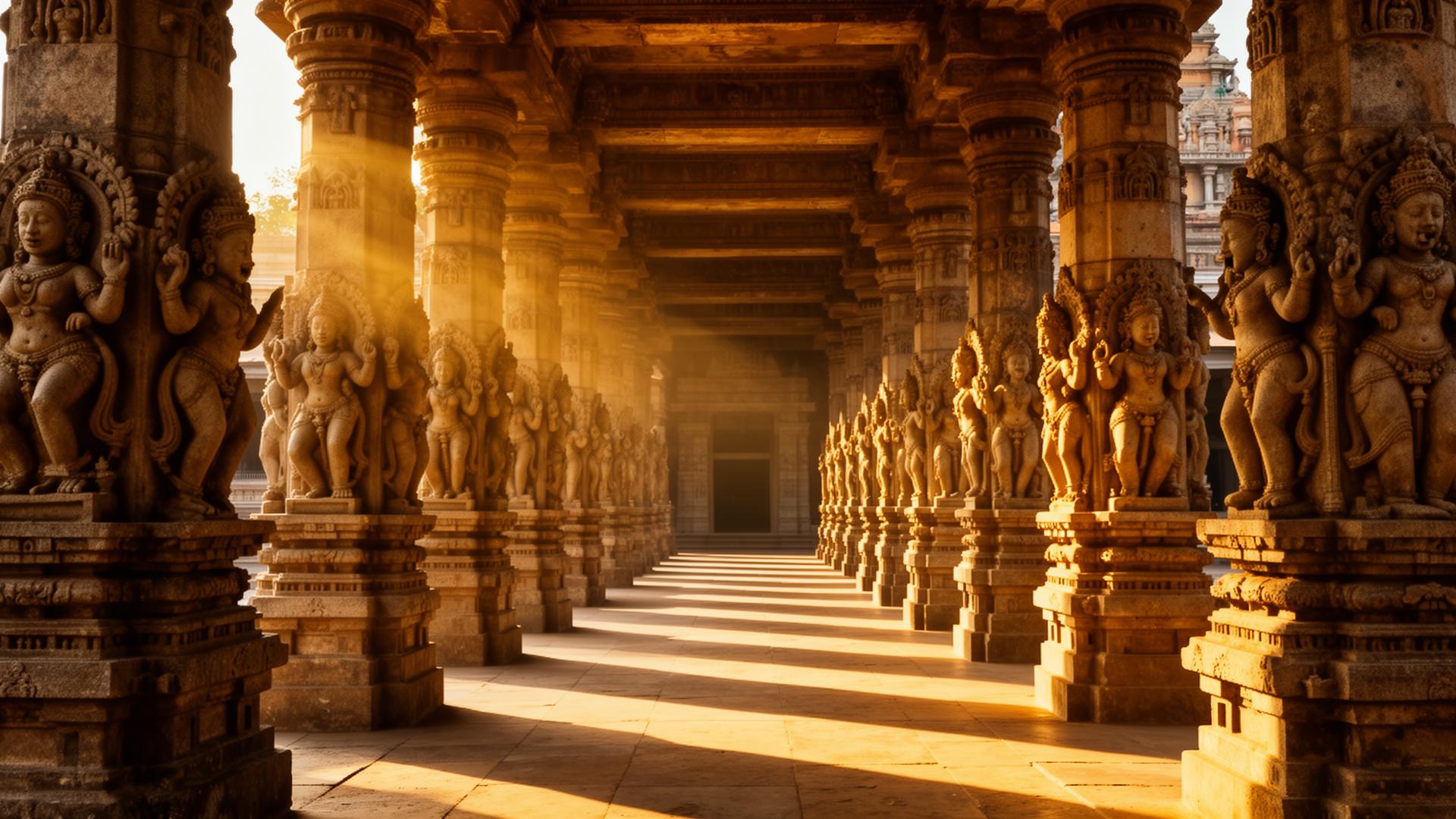
Āyiraṅkāl Maṇḍapam

The Hall of a Thousand Pillars — 985 carved granite columns in perfect rows, each different. Outside it stand the famed musical pillars that ring with the seven swaras when struck.

Pudu Maṇḍapam & Corridors

Long colonnaded streets of the temple-city, lined with sculptures of Nāyak kings, yāḷis, dancers and gods — a complete world enclosed in stone.

Hall of a Thousand Pillars — Ayirakkal Mandapam
Āyiraṅkāl Maṇḍapam — the Hall of a Thousand Pillars at dawn
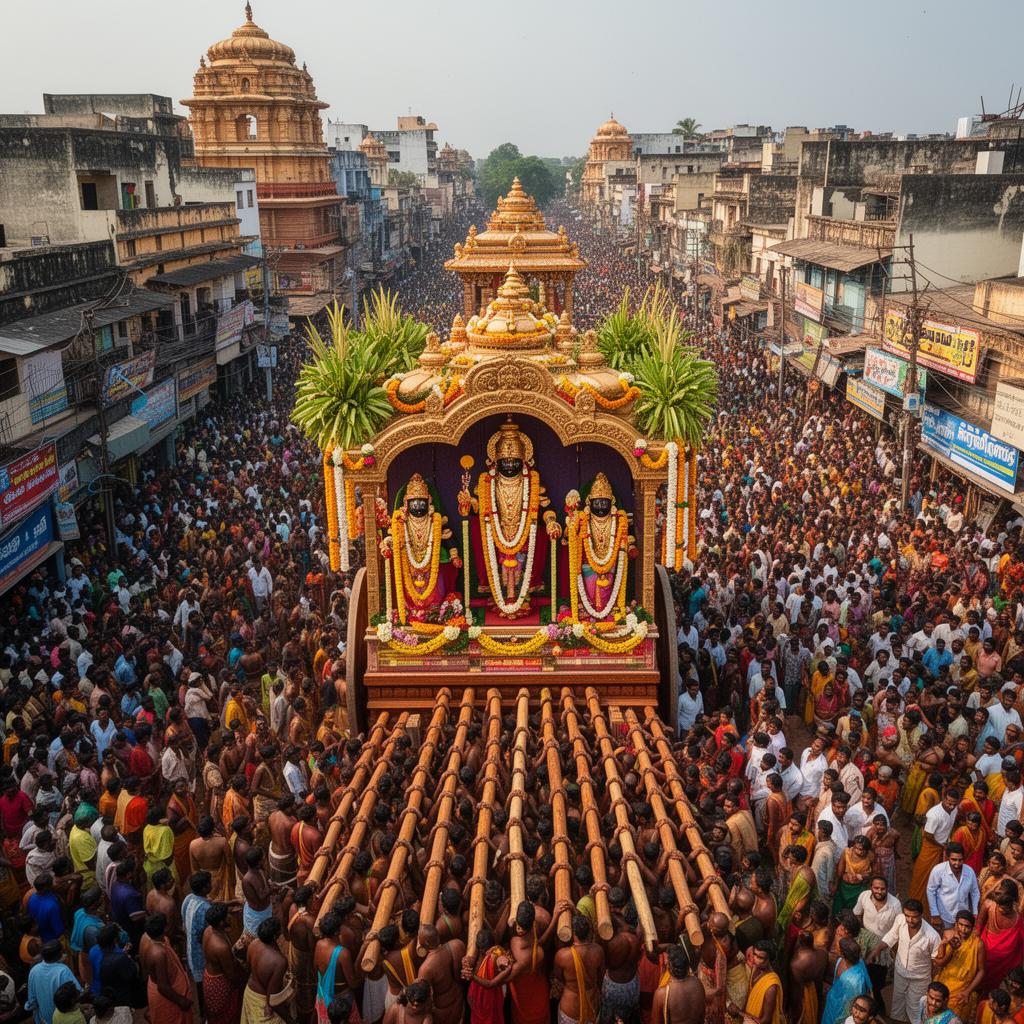
The Chithirai festival procession with deities on the grand chariot

Chapter IV · The Divine Wedding

Chittirai Tiruvilā

For twelve days every April–May, the whole of Madurai becomes a wedding hall. The coronation of Mīnākṣī, her victorious march across the directions, her meeting with Sundareśvara on Kailāsa — every chapter of the story is enacted on the streets. On the day of the Tirukkalyāṇam, the divine wedding itself, Lord Viṣṇu — believed to be Mīnākṣī's elder brother — rides in from Aḻakar Kōyil twelve miles away to give his sister in marriage. Over a million devotees line the streets to witness the Goddess being married to her Lord. The grandest chariot — bearing the divine couple — is then pulled by tens of thousands through the city.

मीनाक्षी मे मुदं देहि ॥

"O Mīnākṣī, grant me joy." — refrain of the Mīnākṣī Pañcaratnam

Chapter V

Daily Worship & Sacred Festivals

The unbroken rhythm of pūjās and tiruvilās that fill every day at Madurai.

Tiruvanantal (5 AM)

The first ritual of the day — the deities are awakened, bathed and adorned before the temple opens to devotees at dawn.

Kālasandhi & Uchikāla Pūjā

Morning and midday offerings of food, flowers and lamps — recited with the chanting of Vedic mantras and Tamil Tēvāram.

Palliyarai Pūjā

Every night the silver palanquin carries Sundareśvara from his shrine to Mīnākṣī's bedchamber — the Lord goes to the Queen, not she to him.

Chittirai Tiruvilā (Apr–May)

The grandest festival — the Mīnākṣī Tirukkalyāṇam, the divine wedding, re-enacted over twelve days with chariots, processions and lakhs of devotees.

Āvaṇi Mūla & Navarātri

The sixty-four Tiruviḷaiyāḍal — the sacred plays of Shiva — are enacted; nine nights of worship honour the Goddess in her every form.

Teppa Tiruvilā (Float)

On the full moon of Tai, the deities are taken in a flower-bedecked float across the great Mariamman Teppakkulam tank by lamplight.

॥ जय मीनाक्षी सुन्दरेश्वर ॥

From the warrior queen born of the sacrificial fire, through two thousand years of Tamiḻ song and stone, to the chariots that still roll through Madurai every Chittirai — Mīnākṣī remains what she has always been: the Sovereign Mother of the South, fierce in her power and tender in her grace, ruling beside her Lord at the heart of a city built entirely for her.

जय माता ॥