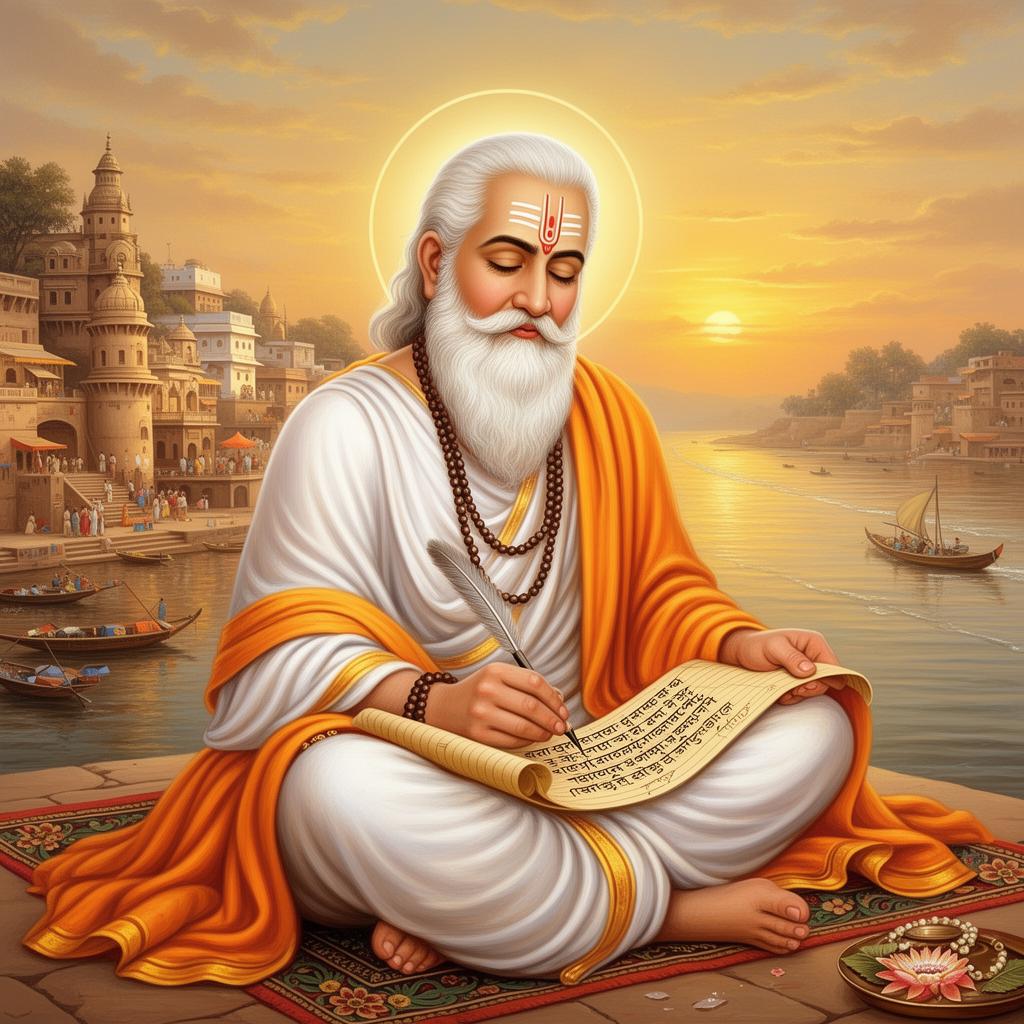
Sant Tulsidas

Saint · Bhakta-Kavi

Sant Tulsidas

॥ सन्त तुलसीदास ॥

The 16th-century poet-saint who poured the story of Lord Rāma into the heart-language of the people — and whose Ramcharitmanas and Hanuman Chalisa still light millions of homes every evening.

॥ ॐ ॥

16th CE

Era

Rajapur, UP

Birthplace

91 yrs

Lifespan

Kashi (Varanasi)

Home

Introduction

The Poet-Saint Who Brought Rāma to the People

॥ ॐ ॥

Sant Tulsīdās (Sanskrit / Awadhi: सन्त तुलसीदास) — born in 1532 CE — is one of the greatest poet-saints in the history of Sanatan Dharma. He is best known as the author of the Ramcharitmanas, a retelling of the Rāmāyaṇa in Awadhi that placed the story of Lord Rāma directly into the hands and hearts of common people.

Tradition reveres him as an incarnation of Vālmīki — the original sage of the Rāmāyaṇa — born again to sing Rāma's glory in the language of the times. Alongside saints like Kabīr, Sūrdās and Mīrābāī, he is a towering figure of the Bhakti Movement, which placed personal devotion above ritual scholarship.

His life and works weave together deep devotion, poetic genius and moral wisdom — making him a beloved guide for every household across Bhārata.
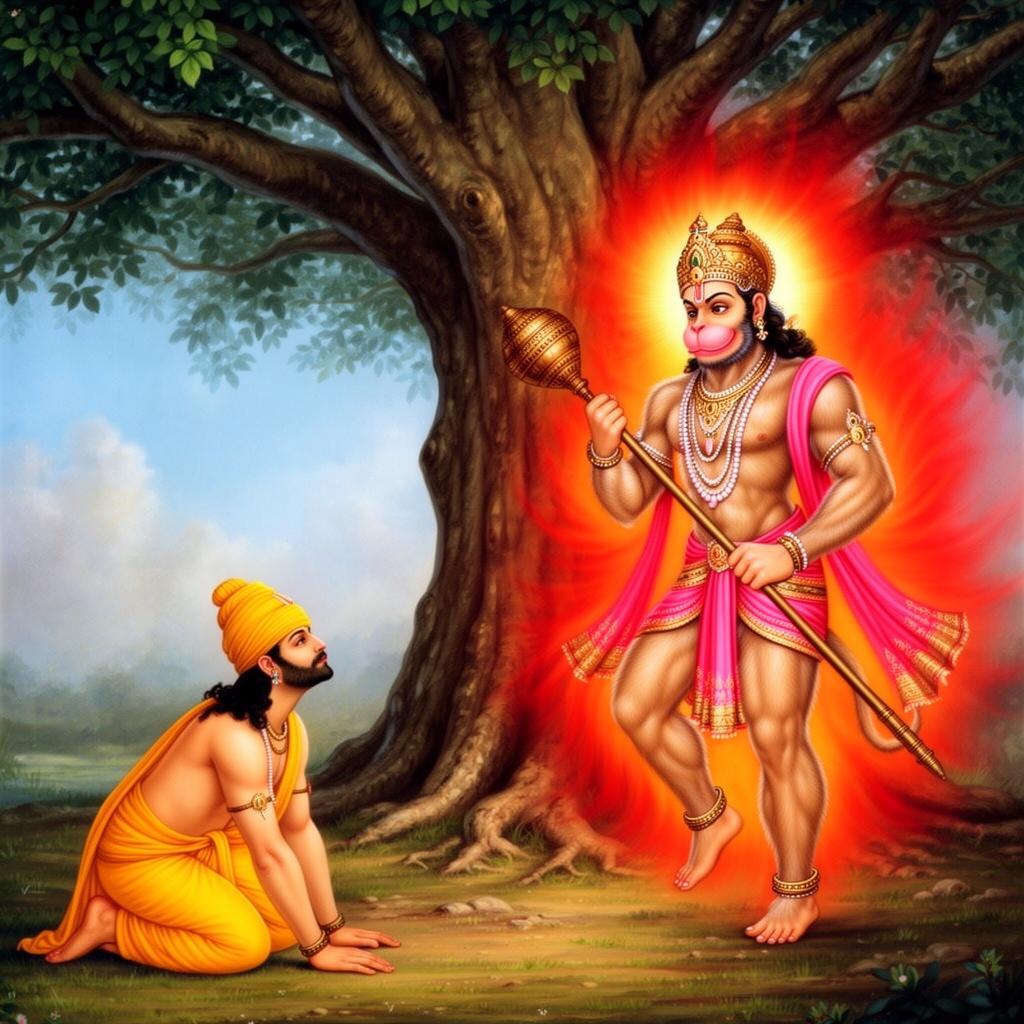
Lord Hanuman revealing his divine form to Sant Tulsidas
The leper at the discourse — Hanuman in disguise

Chapter I

Birth, Guru & the Turn to Rāma

Tulsīdās was born in Rajapur in present-day Uttar Pradesh, near Chitrakoot. Tradition recounts that he was born under an inauspicious constellation and was abandoned shortly after birth — but was found and raised by a wandering ascetic, Narharidās, who taught him Sanskrit and the scriptures.

In his early married life, a piercing moment of vairāgya turned his devotion entirely toward Lord Rāma. He left worldly life and travelled the holy places of Bhārata before settling in Kashi (Varanasi), where he would spend the rest of his life writing, teaching and singing the name of Rāma.

Chapter II · The Heart of His Teaching

Three Pillars of Rāma Bhakti

A path open to every soul — humble, simple and infinitely deep.

राम भक्ति

Rāma Bhakti

Loving devotion to Lord Rama — the simplest and surest path to God in Kali Yuga.

राम नाम

Rāma Nāma

The Divine Name itself liberates — chanting 'Ram' carries the seeker home.

धर्म

Dharma

Truth, humility, compassion and righteous living as the natural fruit of devotion.

For Tulsīdās, sincere devotion is open to every heart — regardless of caste, birth or learning. The Divine Name itself is the boat that ferries the soul across the ocean of saṁsāra.

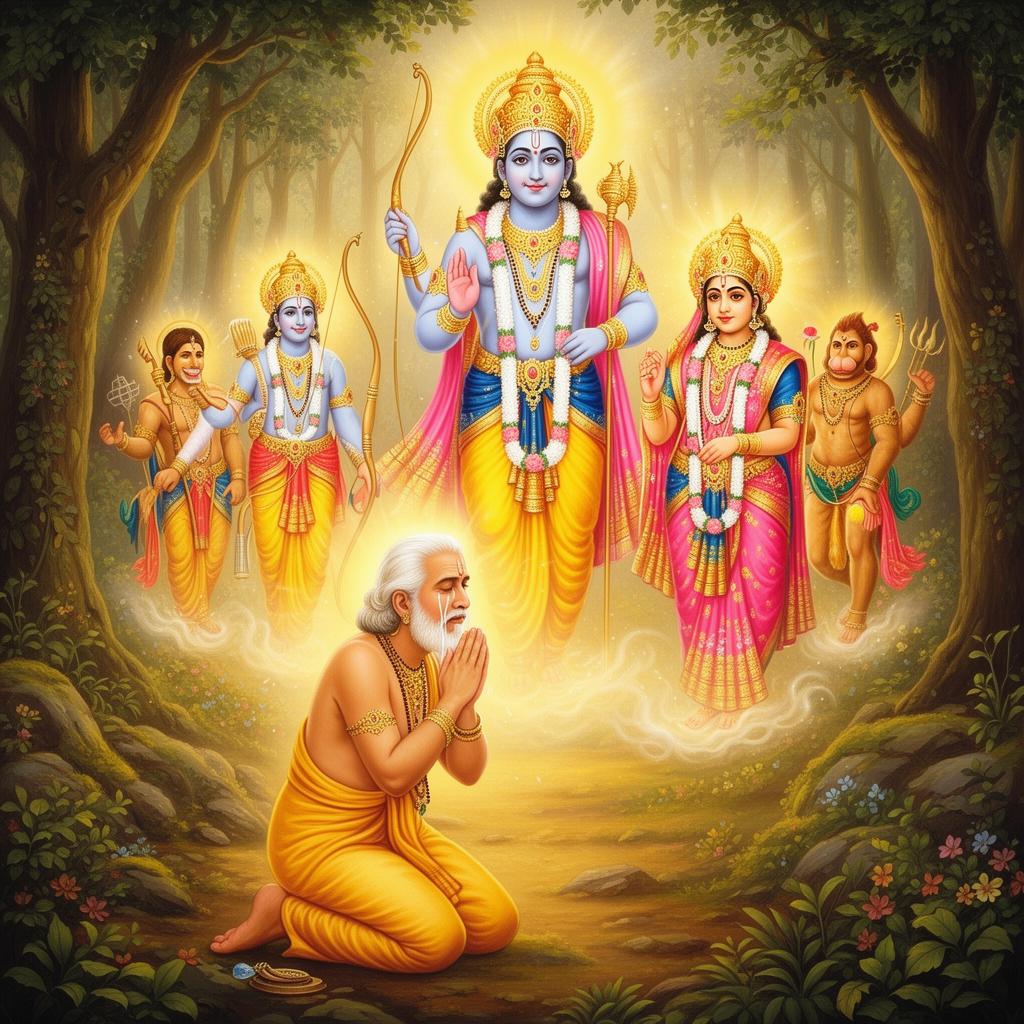
Sant Tulsidas receiving the divine vision of Lord Rama and Sita

Chapter III · Chitrakoot

The Darshan of Lord Rāma

At Chitrakoot, a divine boy quietly approached Tulsīdās and applied a sandalwood tilak upon his forehead, then disappeared. Hanuman later revealed: "That child was Rāma Himself." Tulsīdās wept inconsolably and pleaded for the vision once more — and there in the forest, the Lord granted him darśana with Sītā, Lakshmaṇa and Hanuman. From that vision, the Ramcharitmanas was born.

श्री राम जय राम जय जय राम ॥

Chapter IV · Līlās

Three Episodes from a Luminous Life

Episode 1

Hanuman as a Leper

A humble leper at his discourse turns out to be Hanuman himself — and reveals the path to Rāma's darśana.

Episode 2

The Birds Chant 'Ram'

When orthodox paṇḍits opposed his Awadhi verses, even birds and animals of Kashi began chanting Rām Rām.

Episode 3

Tilak from Rāma's Hand

At Chitrakoot, a divine child mysteriously applied a sandalwood tilak on his forehead — Hanuman later revealed it was Rāma Himself.

Chapter V · Granthāḥ

Twelve Works of the Poet-Saint

Devotional epics, hymns and meditations that became the soul of North Indian bhakti.

The Ramcharitmanas

  • The 'Bible of North India' — seven kāṇḍas in Awadhi
  • Made the Rāmāyaṇa accessible to every home
  • Recited daily across Bhārata for five centuries

Hanuman Chalisa

  • Forty verses in praise of Hanuman
  • The most chanted devotional poem in Hinduism
  • Removes obstacles, grants strength and protection

Other Granthas

  • Vinaya Patrikā — prayers of surrender
  • Dohāvalī · Kavitāvalī · Gītāvalī
  • Vairāgya Sandīpinī · Pārvatī Maṅgal · Jānakī Maṅgal

Chapter VI · The Living Tradition

Ramlila & the Daily Recitation

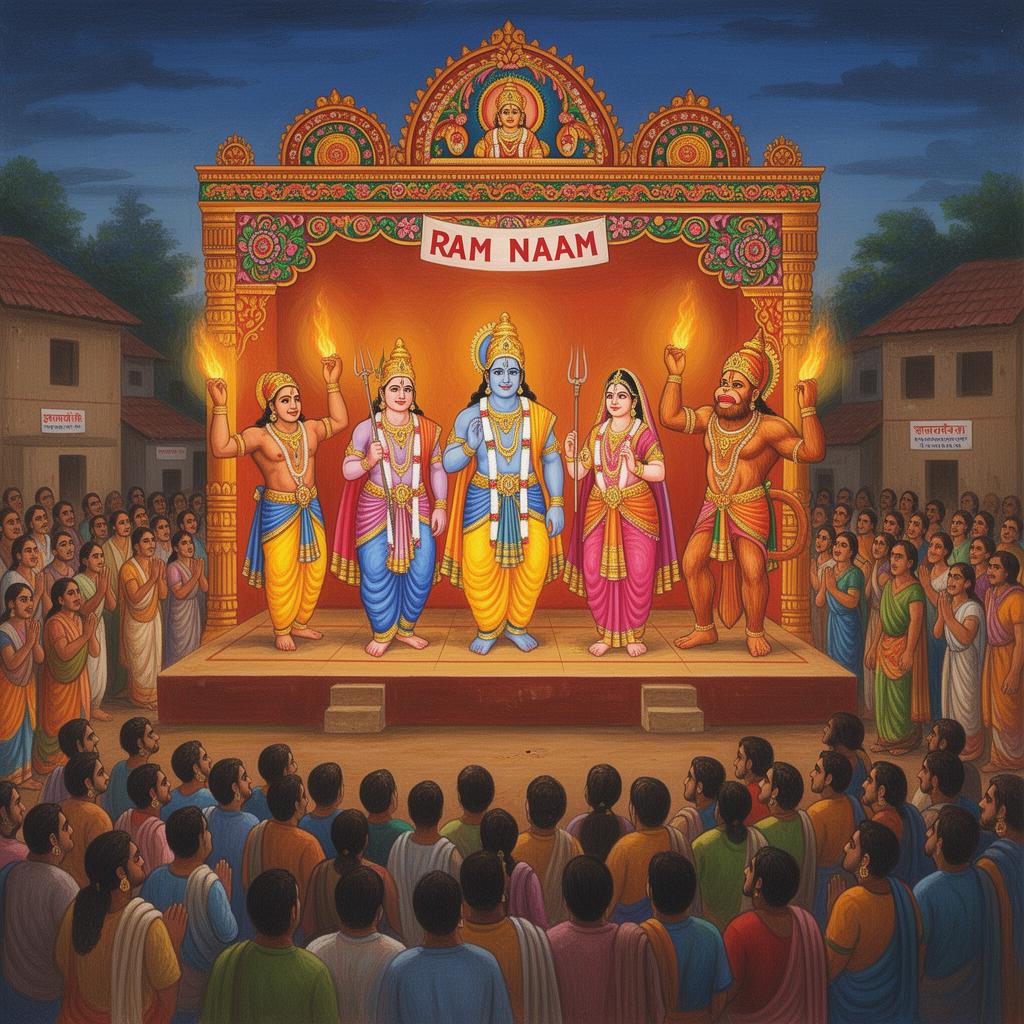
The annual Rāmlīlā performances during Navarātri across North India draw almost entirely from Tulsīdās' verses. Every autumn, village and city stages alike come alive with the Manas — Rāma, Sītā, Lakshmaṇa and Hanuman walking once again among the people.

Every morning the Hanuman Chalisa rises from countless homes; every evening, families gather to read a chaupāī of the Manas. This is the quiet, vast presence of Tulsīdās in the daily life of Bhārata.

A traditional Ramlila performance in a North Indian village
Ramlila — Tulsīdās' Manas walking among the people

Caupāī & Dohā

Words of the Saint

॥ ॐ ॥

Ramcharitmanas · Bāla Kāṇḍa

मंगल भवन अमंगल हारी। द्रवउ सो दसरथ अजिर बिहारी॥

"May He who is the abode of auspiciousness and the destroyer of all inauspiciousness — He who plays in Dasharatha's courtyard — bless us with His grace."

Hanuman Chalisa · Opening dohā

श्रीगुरु चरन सरोज रज, निज मनु मुकुरु सुधारि। बरनउँ रघुबर बिमल जसु, जो दायकु फल चारि॥

"Cleansing the mirror of my mind with the dust of my Guru's lotus feet, I sing the pure glory of Sri Raghuvar — who grants the four fruits of life."

Life Journey

A Life of Ninety-One Years

  1. 1532 CE

    Born in Rajapur near Chitrakoot to Hulsī and Ātmārām Dubey.

  2. Childhood

    Raised by the wandering ascetic Narharidās; learns Sanskrit and the scriptures.

  3. Turning point

    A startling moment of vairāgya turns his life wholly toward Lord Rāma.

  4. Varanasi

    Settles in Kashi; composes the Ramcharitmanas in Awadhi (begun 1574 CE).

  5. Vision

    Receives direct darśana of Lord Hanuman, and later of Rāma, Sītā and Lakshmana at Chitrakoot.

  6. 1623 CE

    Leaves his body on the banks of the Ganga at Asighat, Varanasi.

The Pillar of the Bhakti Movement

Tulsīdās combined poetic genius, deep devotion and spiritual wisdom — and through the Ramcharitmanas and the Hanuman Chalisa, he brought Lord Rāma into the daily breath of an entire civilisation. His message stands clear and gentle: a pure heart and the sincere chanting of the Name is enough.

॥ जय श्री राम ॥

"Victory to Lord Rāma — the refuge of all beings."

॥ सन्त तुलसीदास की जय ॥